Antumbra

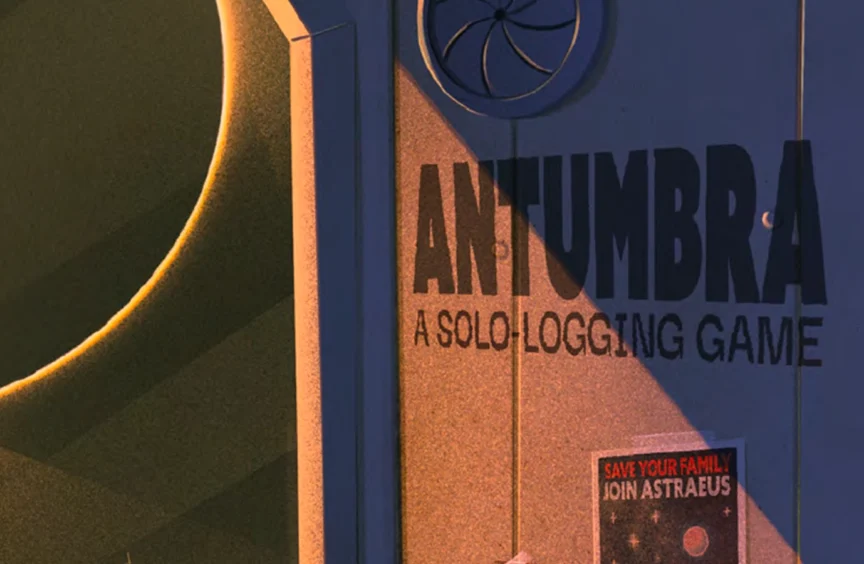
You are awake!
You weren’t supposed to wake up yet.
You are a crew member aboard the Astraeus, a generation ship 270 years into a 580 year voyage. CHARON, the ship’s AI assures you that it’s a minor fault causing your premature awakening– nothing to worry about, but you have to be kept separate from the generational crew for the safety of all parties. She has a routine ready for you, and answers for every question you think to ask. As you piece together the events of the voyage so far through recovered documents and artifacts, what you choose to do with what you find will define who you are and what the Astraeus becomes.
What is Antumbra?
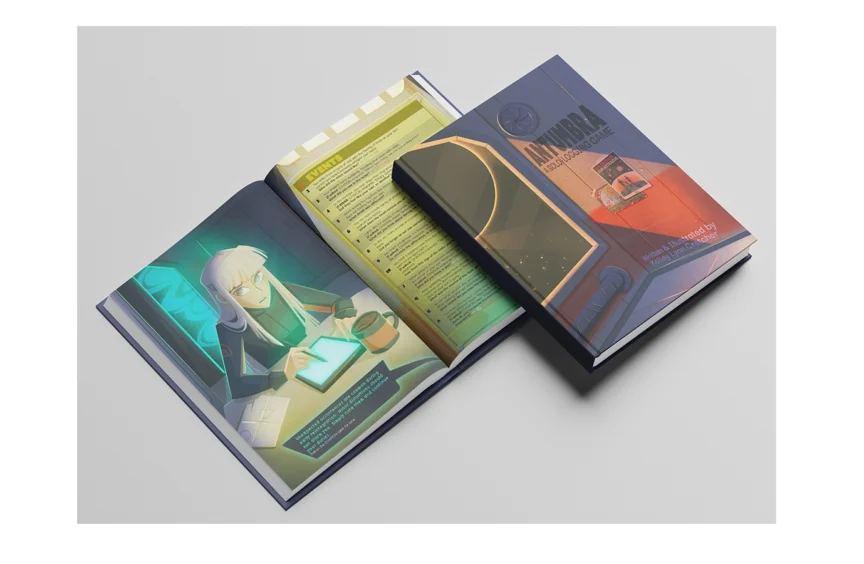
Antumbra is a solo logging TTRPG about isolation, moral weight, and what you owe to a mission bigger than yourself. Quiet and introspective, it draws on the tradition of slow-burn science fiction and gothic storytelling. Every choice you make is your own. Every consequence belongs to you. Through writing prompts and discoverable ephemera you will tell your story of your experience on the ship.
196 pages. Nearly fully illustrated.
Four semi- branching chapters.
Six endings.
One question: who gets to decide the fate of humanity?
“I made this game because I wanted to explore what happens when there is no right choice, only the one you make, what it costs, and why you make it. Solo play became the format because isolation is both the setting and the experience. You sit alone with these decisions. You feel their weight. You’re not just playing a story, you’re creating it. ”
Who are you?
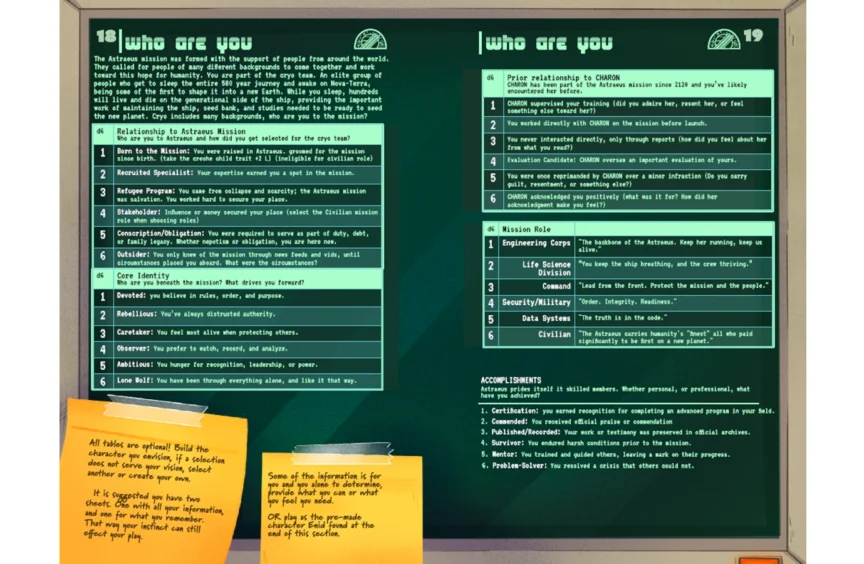
Play as the pre-made Enid, Use the character creator, or randomize your character!
Character creation includes backgrounds, traits, relationship to the mission, roles etc. This allows for a variety of unique characters to play as.
In playtests we had clueless billionaires who bought their way on, a character who helped implement CHARON and was maybe in love with her. We had new players who enjoyed just being engineers or life science officers with no memories, but wildly different personalities.
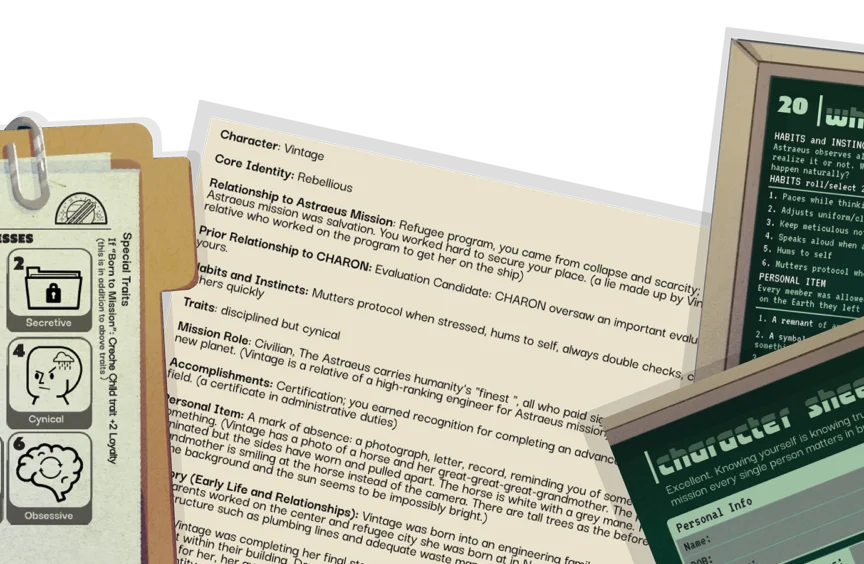
How do you feel about what you find?
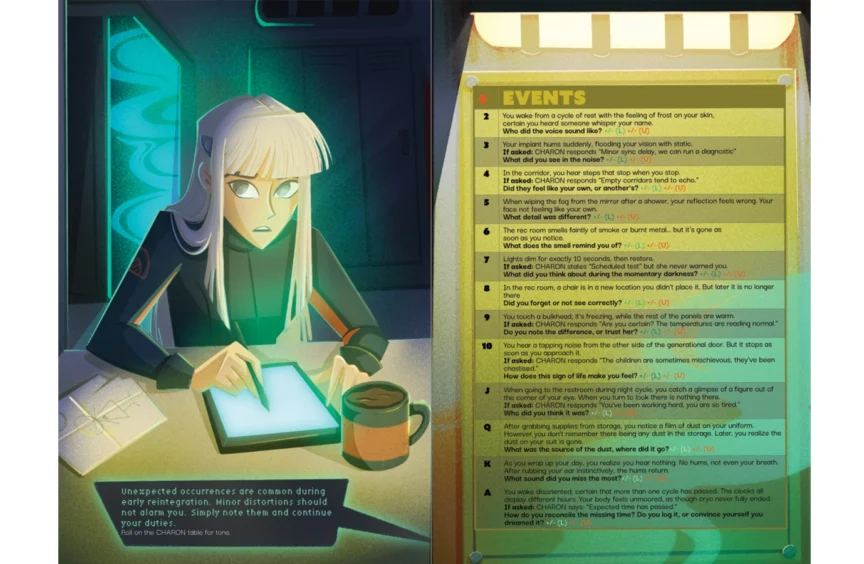
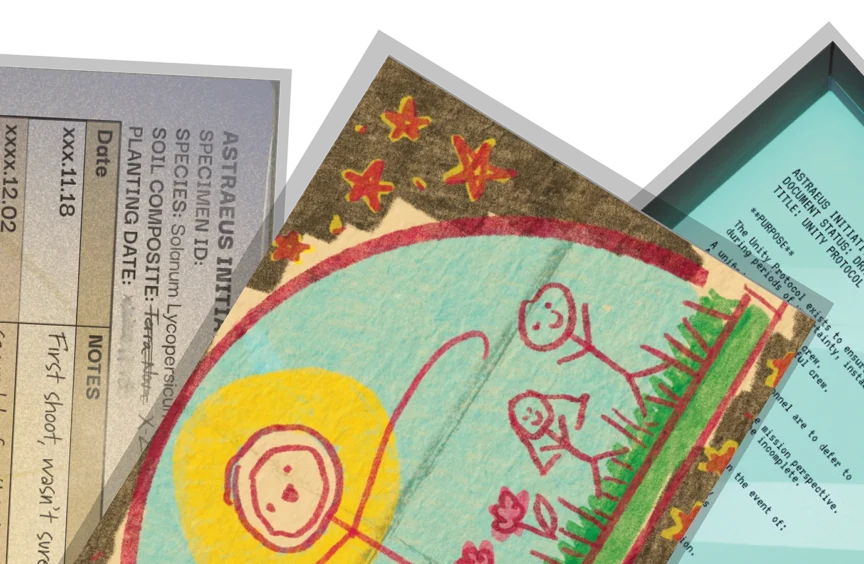
You are alone in this game and there are no NPCs to deliver information. Much of what happened on the Astraeus is pieced together from documents found.
Eagle eyed players may see hints to the events sooner. But those who don’t know won’t be missing out.
These documents give a snapshot of the generational crew’s lives and how the mission has been progressing.
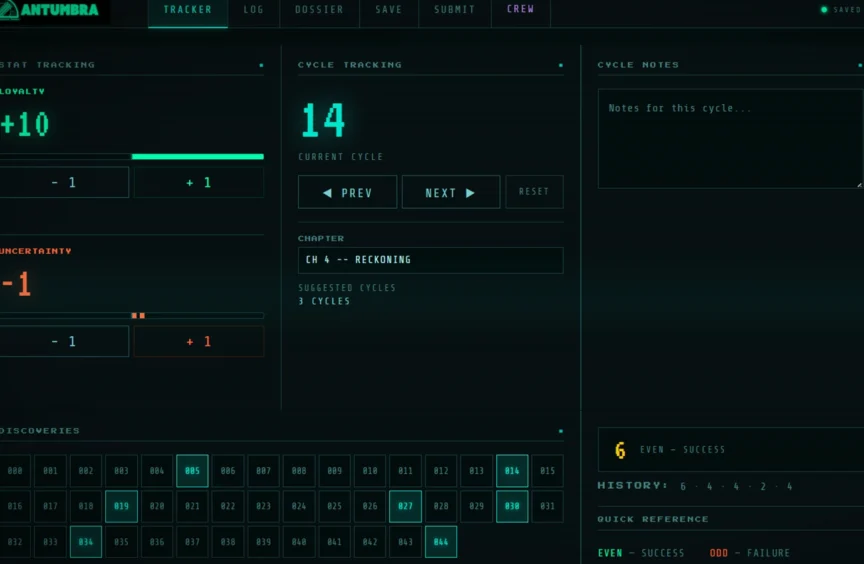
No table? No problem!
The Crew Companion website allows stat tracking, log entry, card drawing, dice rolling and more!
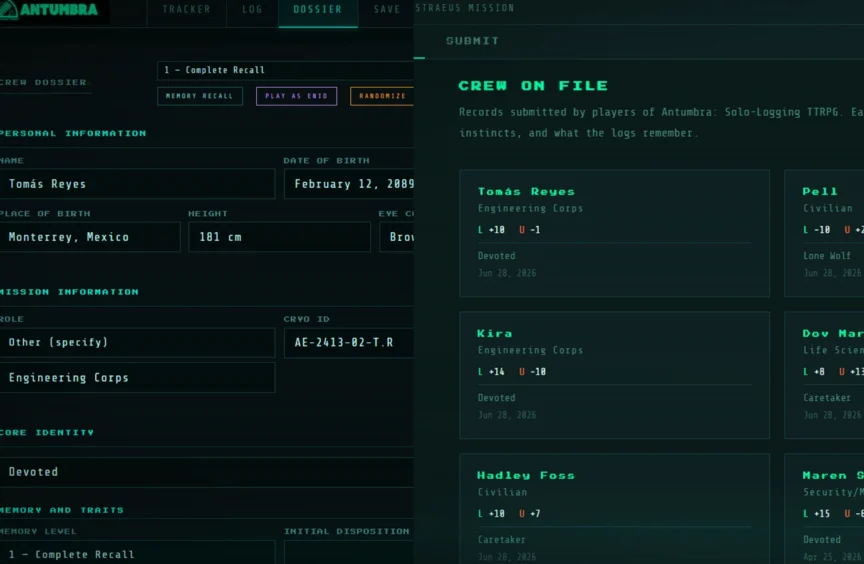
Track your character (or randomly generate one), handle memory loss, and even see logs submitted by other players!
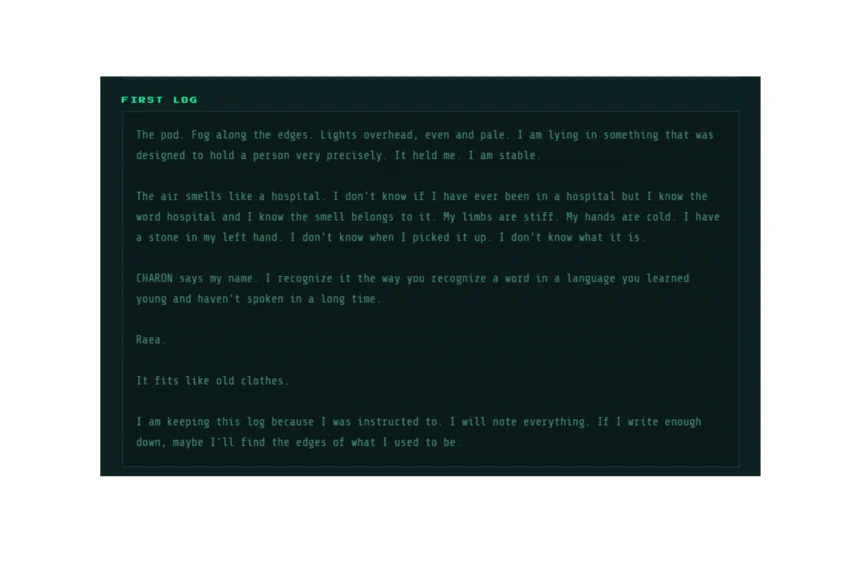
Why did I make this?
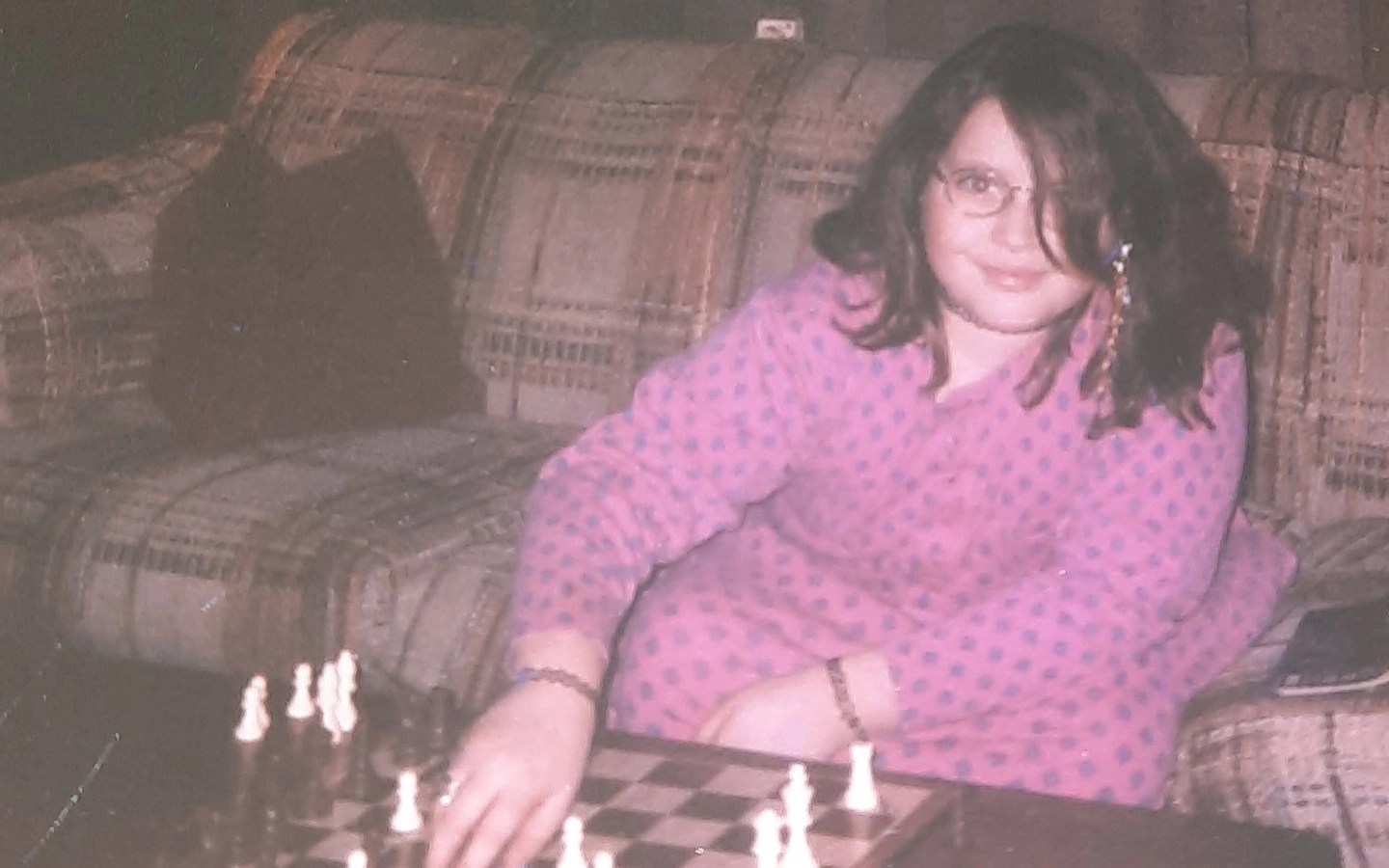
Antumbra, is a love letter to myself. The weird kid who read too much Gothic and science fiction, who wanted to wake up in a different world and figure it out herself. Who never had enough players to play the board games she wanted to play. It also speaks to me as a teacher, I don’t just want to give you a story to click through, I wanted to provide a framework you can use to build your own story from.
How was Antumbra Made?
Viewer as Participant
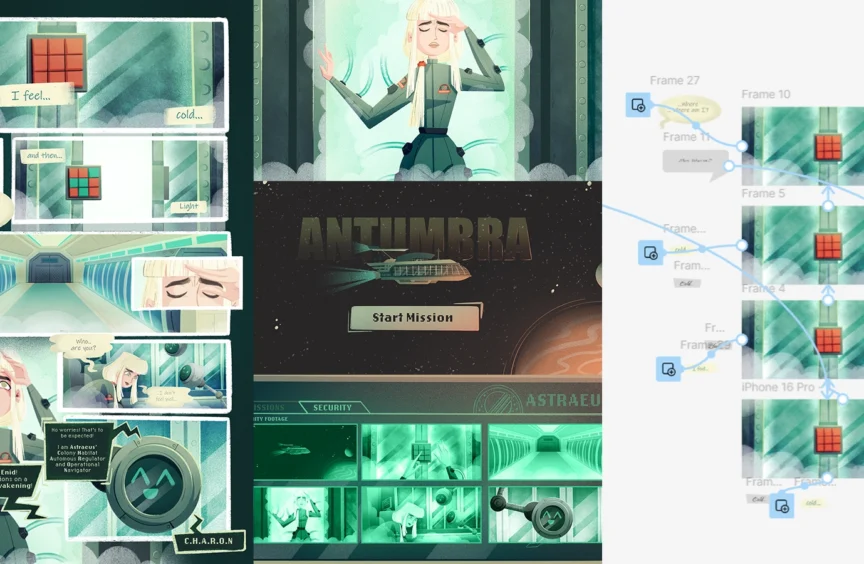
Antumbra started as a comic, then a visual novel. But as I explored interactivity in my work I wanted more creative freedom for my players. Finally it settled as a TTRPG which allowed the most freedom. I didn’t want the players to just flip pages, or click through the story. I wanted them to feel like active participants.
Enid and CHARON
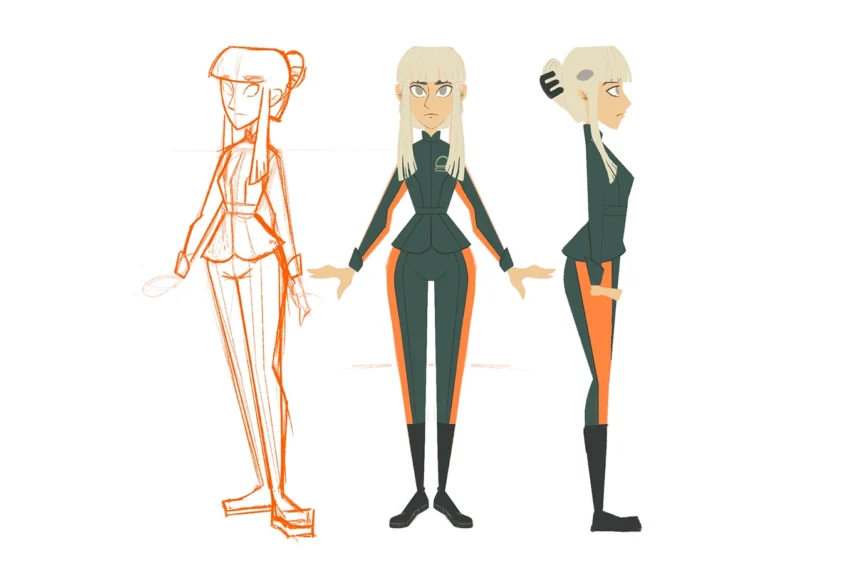
In every iteration of Antumbra, the story centered around a lone character waking from cryo with the ship’s AI for company. Enid (Ee-nihd) was named in honor of my Welsh heritage, as well as my mother’s maiden name, Tewell (two-wuhl). Regardless of what form the project took, she was always going to be a character to experience the story through.
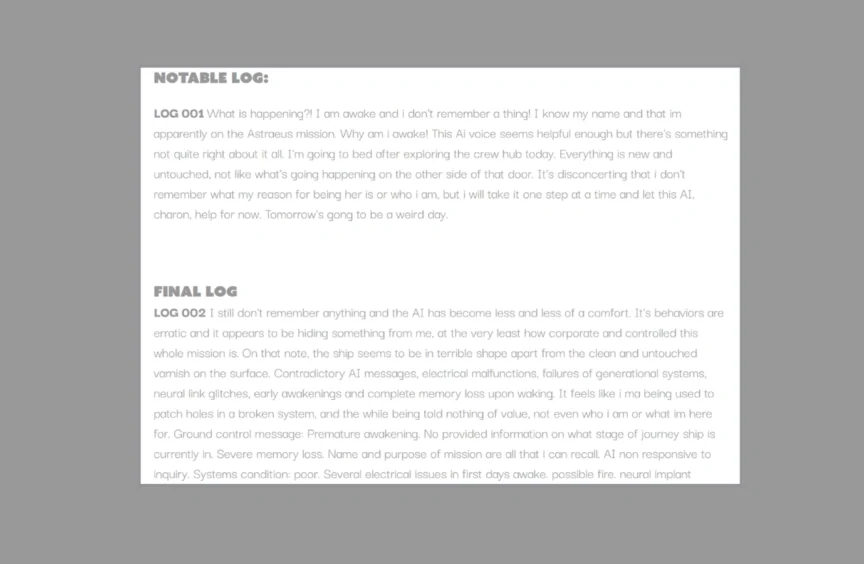
When the project shifted to a TTRPG, character creation became something to account for, not every player wants to step into a pre-written character. Enid stayed on as the example, her logs appearing at the end of every chapter and her character present throughout much of the art. Players who prefer a more guided experience can opt to play as Enid directly using the pre-made character sheet.
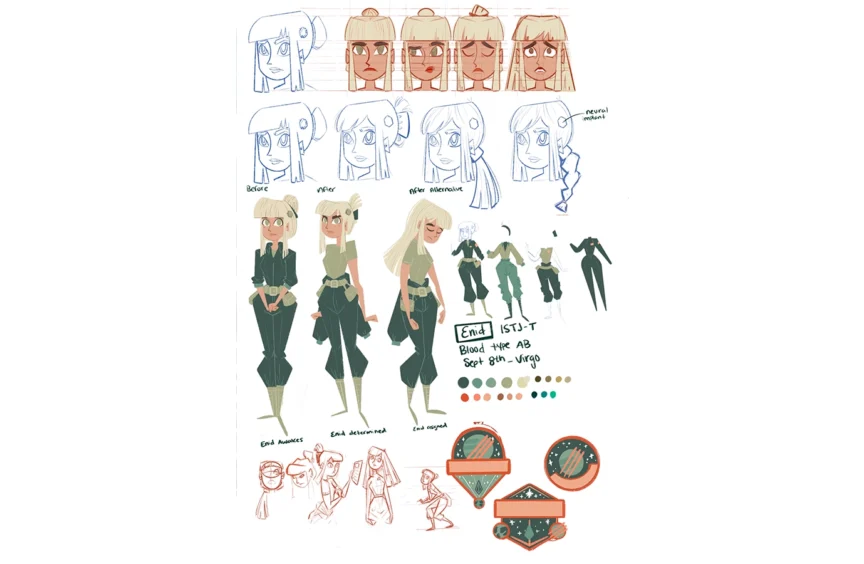
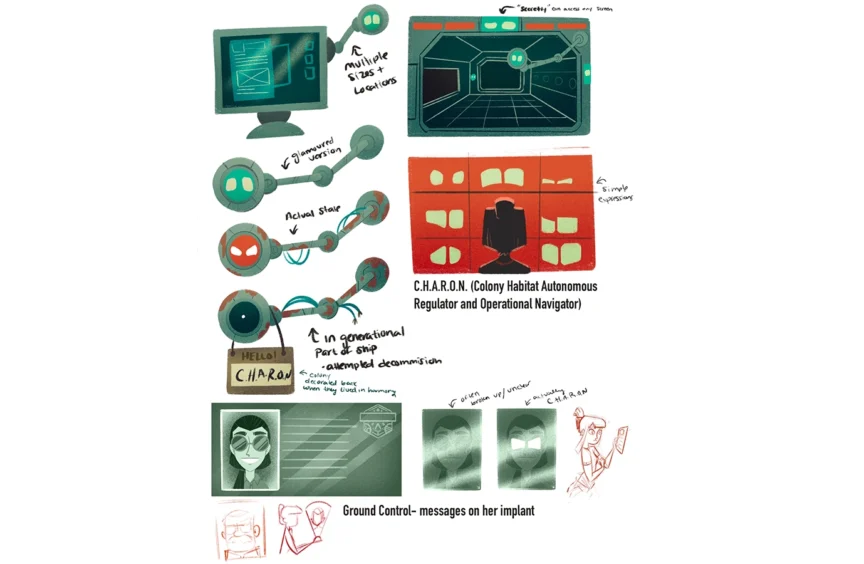
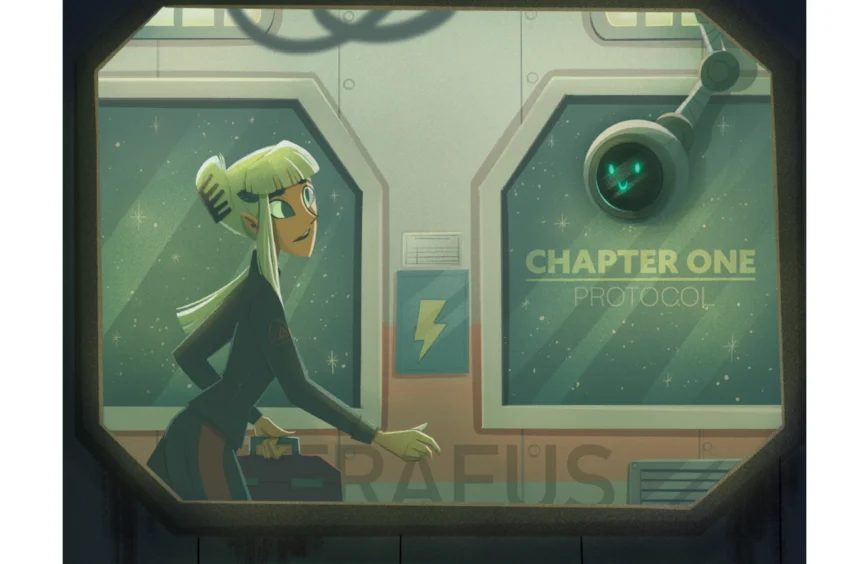
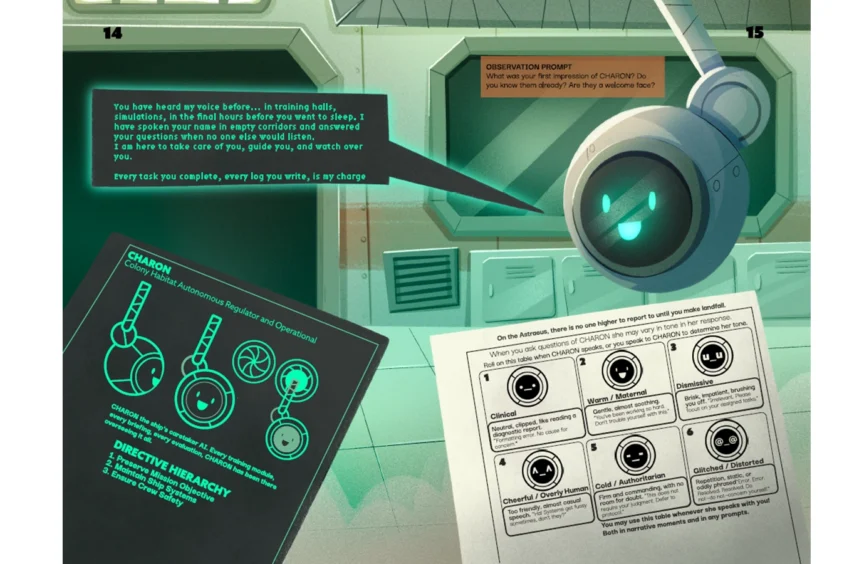
CHARON (Keh-ruhn, or Karen) remained largely unchanged throughout the project. I wanted a constant presence, but one that also carried some nostalgic, retro energy. The mechanical arm was a deliberate choice, it adds fragility, and with it a sense of helplessness that works against the obvious rogue AI read. It also implies limitation in presence, which was important to the story.
The Play-Test
Staying neutral and not getting crunchy
There is no morally correct answer in Antumbra. That was always the intention, but getting there meant fighting against decades of rogue AI stories, including ones I’d absorbed myself.
Every phrase involving CHARON was scrutinized. Every illustration. The wrong word or the wrong color palette and a player would walk in already assuming the worst. From the beginning I asked play-testers to flag any moment they felt pushed, or when they felt told how to feel rather than having room to decide. I wanted some instability; that’s the part of what makes the setting work. I just didn’t want it tipping into a verdict.
It required constant revision. Reflection prompts, narrative text, dialogue, all went through multiple passes. Play-testers tend to feel it lands neutrally, but I know this will need watching for as long as the game is being developed.
In the end only two stats were needed. Uncertainty and Loyalty
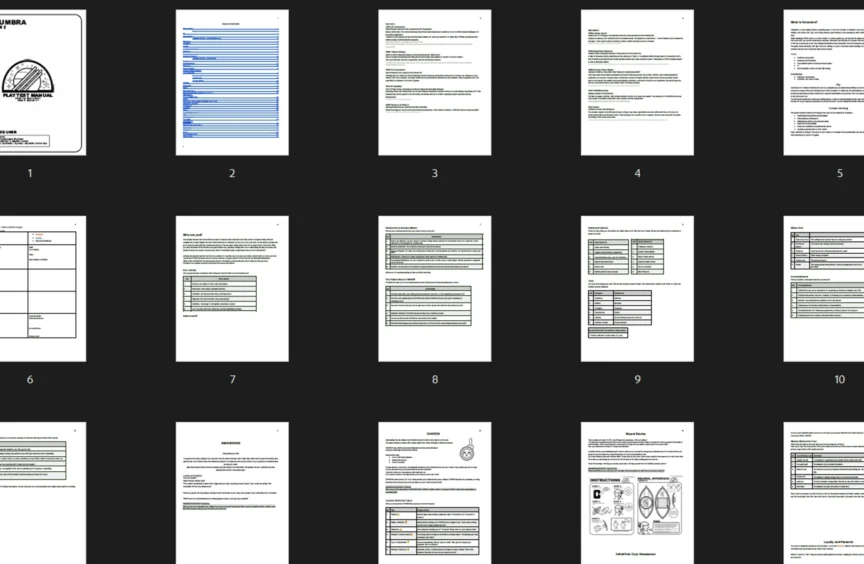
Over 90 pages written. 6 play-test versions. Tons of iterations and adjustments.
The Art
Not just tables!
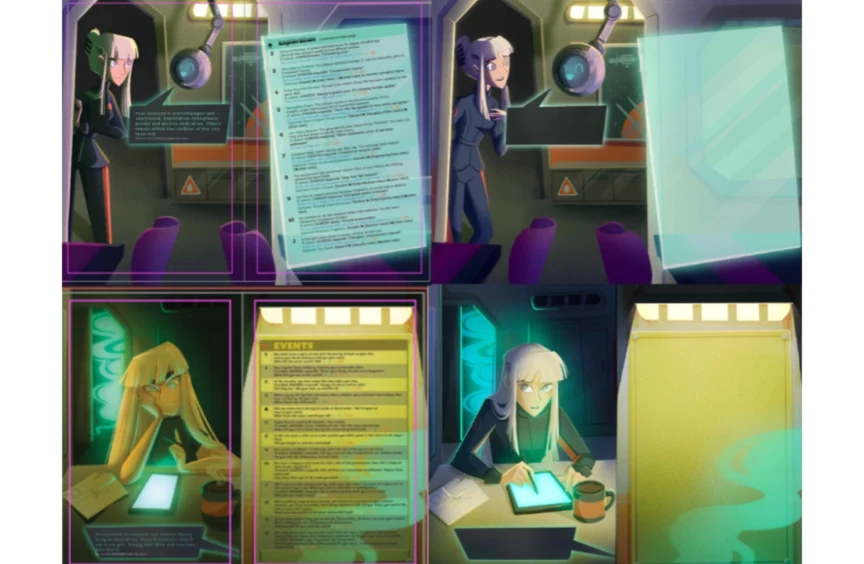
One of the major goals of this project was to have the game book be fully illustrated. Due to the indie nature of the solo ttrpg genre, many are sparse with art. I was inspired by game-books like Mork Borg, which balanced form and function, and wanted to utilize the illustrations for immersion and world building. This allowed the text to focus on narrative and mechanic delivery while having the atmosphere and tone reinforced through the art. I also was dedicated to more diegetic use of illustration and text, especially given the number of tables present. I wanted to ensure even these tables were integrated in a visually interesting way that continued to keep the players immersed.
Thumbnails→ Basic Colors→ Lighting→ Render
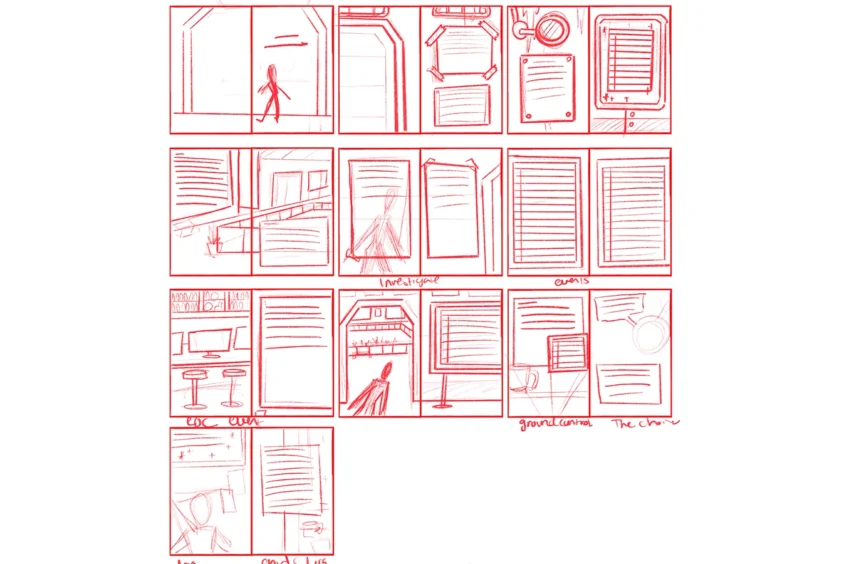
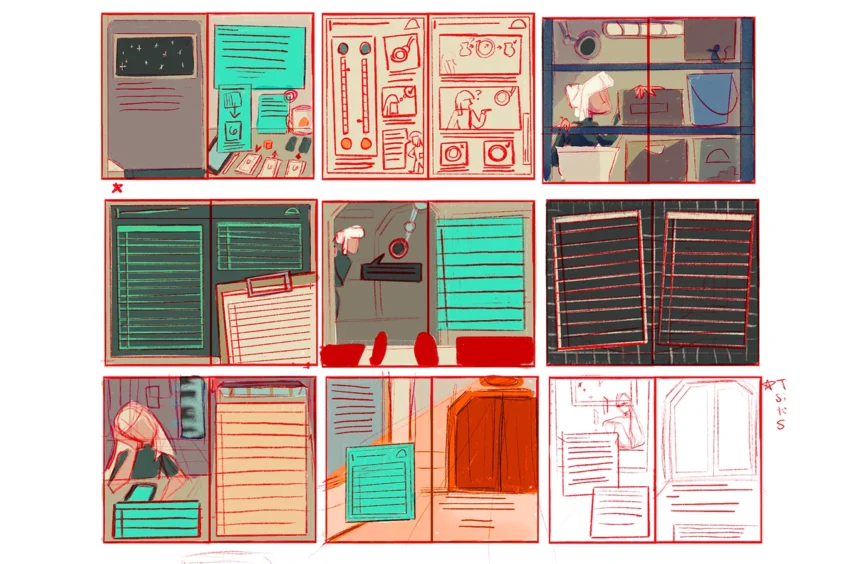
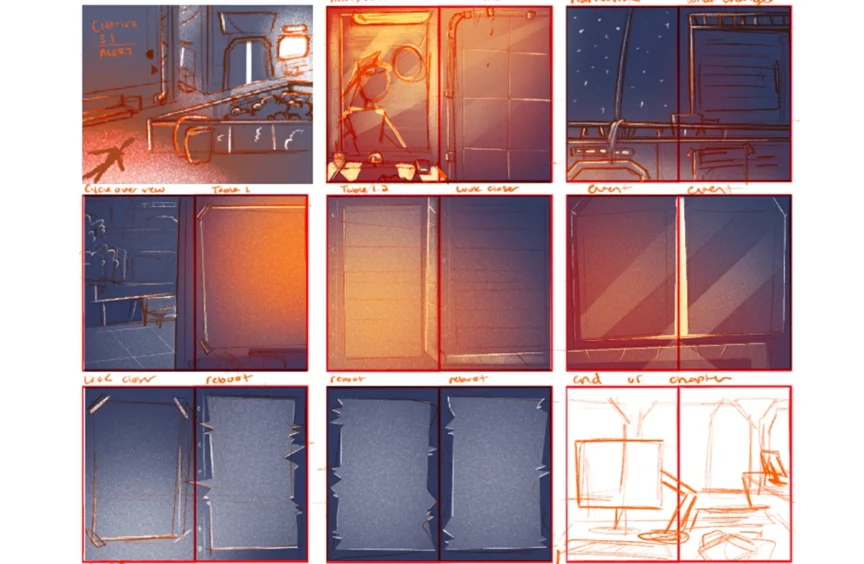
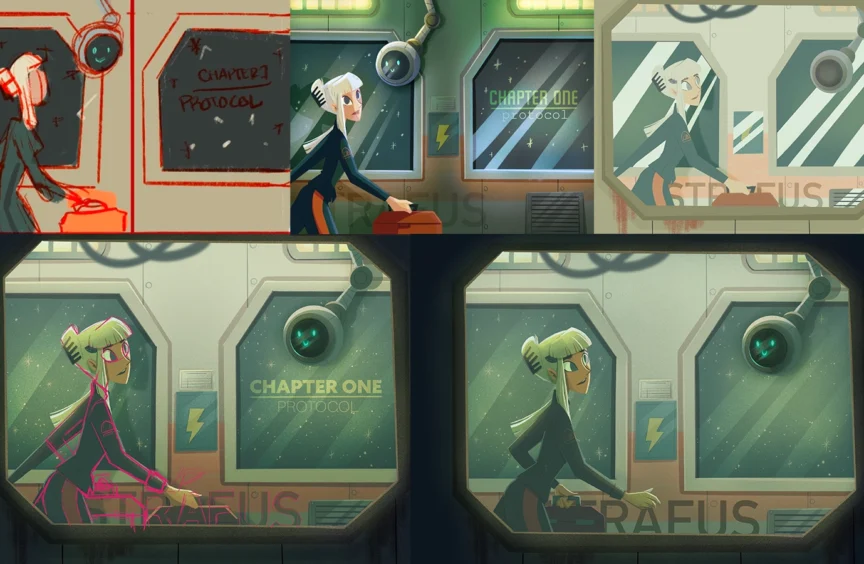
Due to the scale of the project, many got redrawn as my skills improved and the direction was settled on.
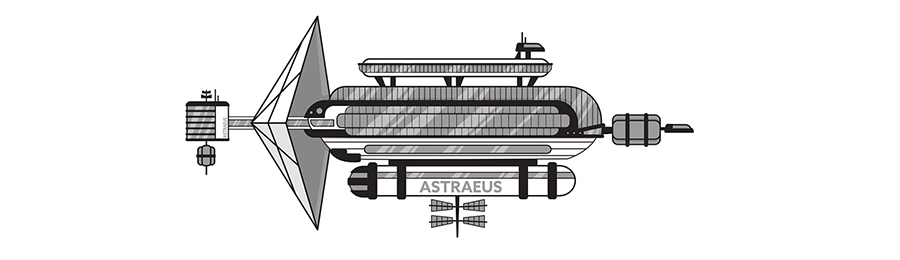
The Ship
Building the Astraeus
The Astraeus (ah-stree-uhs) started as an aesthetic exploration: a retro-futuristic take on a large ship, cruise ships as the main reference. It looked the part, but wasn’t particularly function or original.
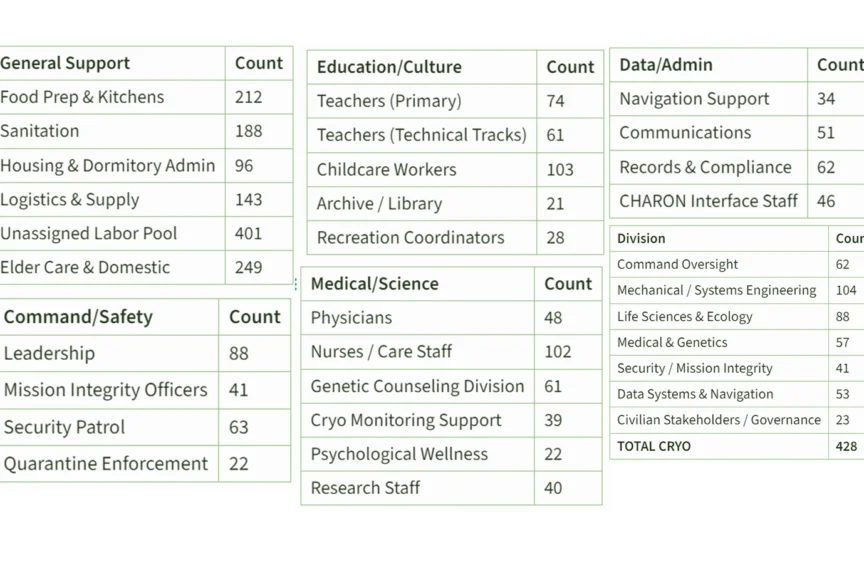
Researching Minimum Viable Populations changed that. PVA (Population Viability Analysis) simulations by Roman V Yamplosky, Marin, and Beliffi put the minimum viable colonist count at roughly 5,000 without CHARON intervention, 500 with. I settled on a seed cohort of 2,880, implying some CHARON involvement, with a natural growth rate of 6.7 people per year. That brings the generational crew to 3,764 at the time of the story.
The Astraeus design was now about supporting such a population, while maintaining overall aesthetics.
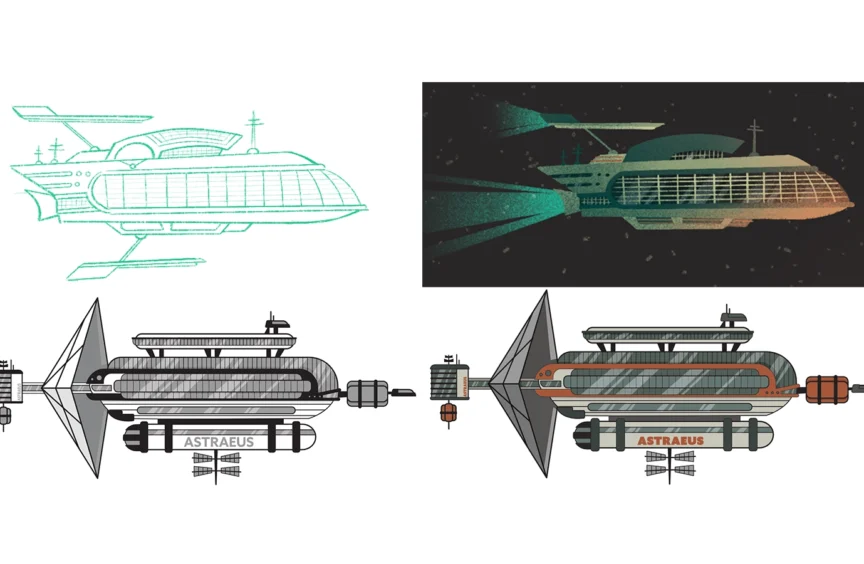
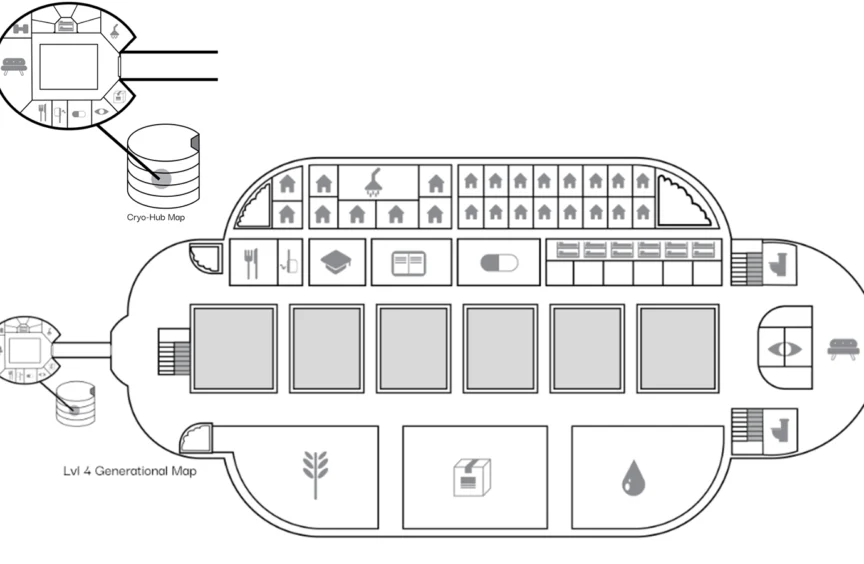
To support a population that size plus 428 cryo crew, the ship would most likely need to be assembled in space. I worked through propulsion options (light sails), resources (water tanks, solar panels, seed bank storage), and structural segmentation, with components that could potentially be re-purposed for colony building once the Astraeus reaches Nova Terra.
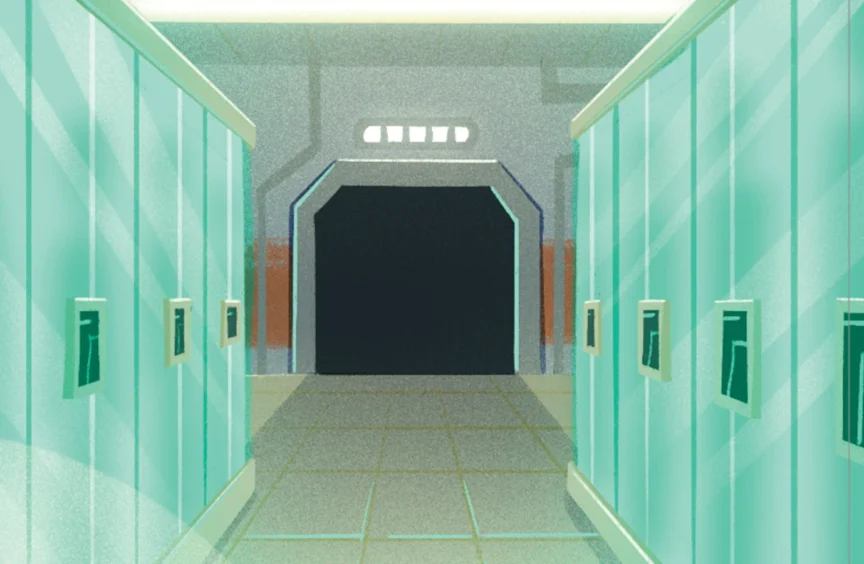
Mapping the layout of both the cryo and generational sections mattered beyond reference. The prompts needed to be grounded in something feasible, and the gen crew spend their entire lives on this ship. The space needed to feel like a settlement, not transit. The detailed population breakdown turned out to be more useful than expected (having been a late night rabbit hole). Having exact numbers made decisions about space distribution concrete rather than approximate.
The Branding of the Astraeus
Corporate Minimal
The Astraeus Initiative was heavily inspired by corporate identities found in science fiction films and books. Most notably organizations like Weyland Yutani (Alien 1979). Astraeus isn’t evil, but it is a corporation, and it does get to say who is part of the future of humanity. The goal was for it not to be a stereotypical evil group, rather that there is no ethically correct answer when making choices so large. The goal was very much capitalism, but with a “friendly” twist that allowed for some questionable undertones.
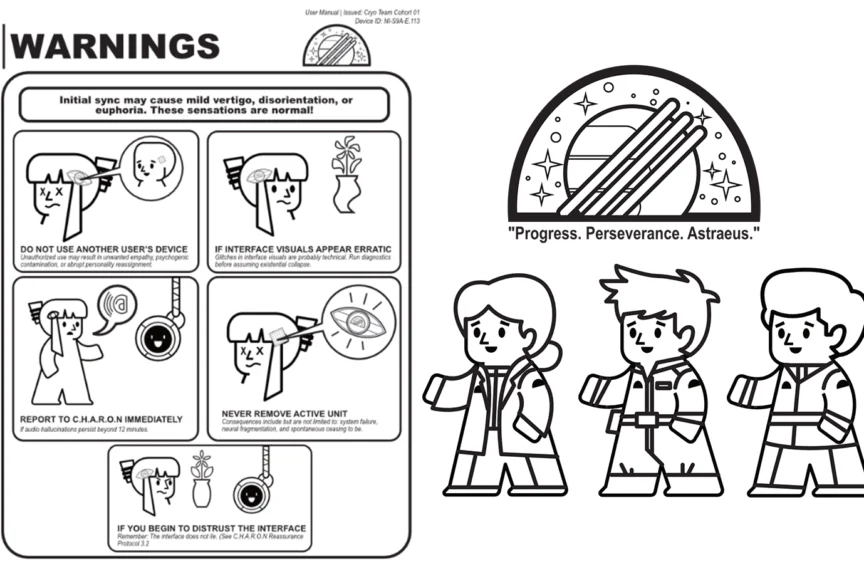
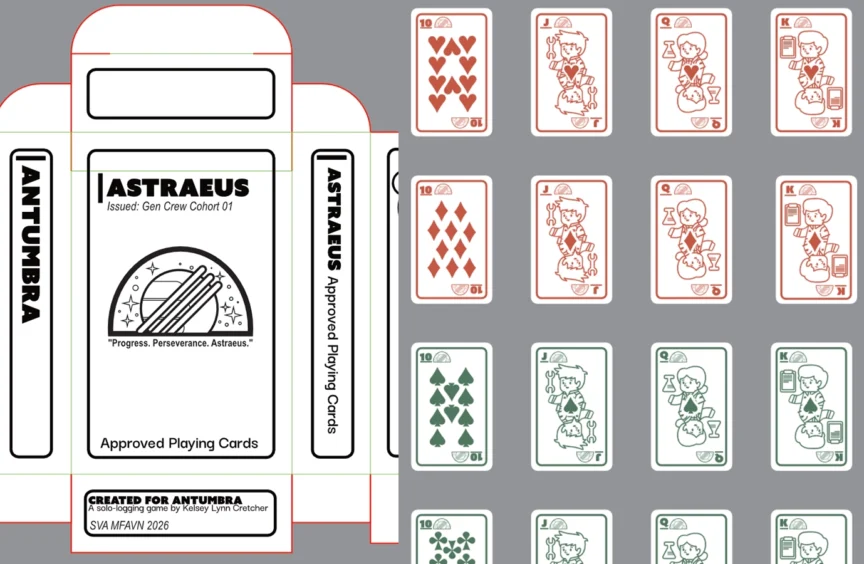
The Standard-Issue Card Deck
While the branding aesthetic appears throughout the book in more instructional instances, I wanted to put it to work in a functional way. The game relies heavily on card draws, which made me think of cheap corporate hand-outs or standard issued materials a mission might have. So as a special limited edition aspect I created a deck of cards to be used with the game. Eventually I’ll have these implemented into the companion site.
Who am I?
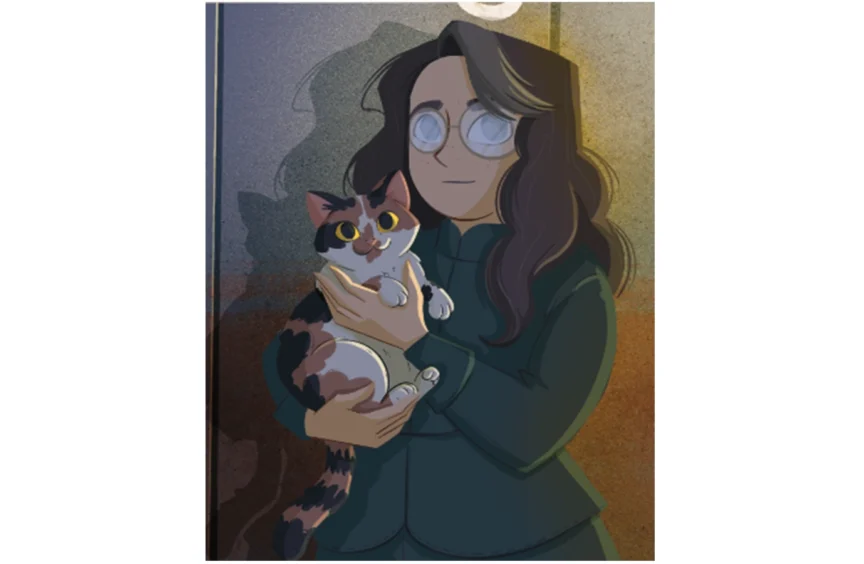
Kelsey Lynn Cretcher
I am an illustrator and game designer based in Cleveland, Ohio, where I live with my fellow illustrator partner, Bill Appledorn, and three cats of questionable behavior, but undeniable cuteness. I hold a BFA in Illustration from the Cleveland Institute of Art, where I now serves as a Professor of Practice in Illustration.
My professional work includes MetaZoo and Tuesday Knight Games, and is featured on Tabletopia and BoardGameArena. As a digital artist, I explore graphic shapes and a passion for texture. My projects and inspirations are shaped by a longstanding interest in the viewer as a participant. My influences come from quiet science fiction and Gothic storytelling, work that builds dread through restraint and leaves room for the audience to complete it.
When I’m not drawing or writing prompts that make players make questionable choices, I’m working through a backlog of fiction and an equally unreasonable backlog of video games.
Want to play?


